
Putin is Getting Very Scared
Hiding in bunkers, fearing assassination, as his Ukraine war goes badly and security services grow restless
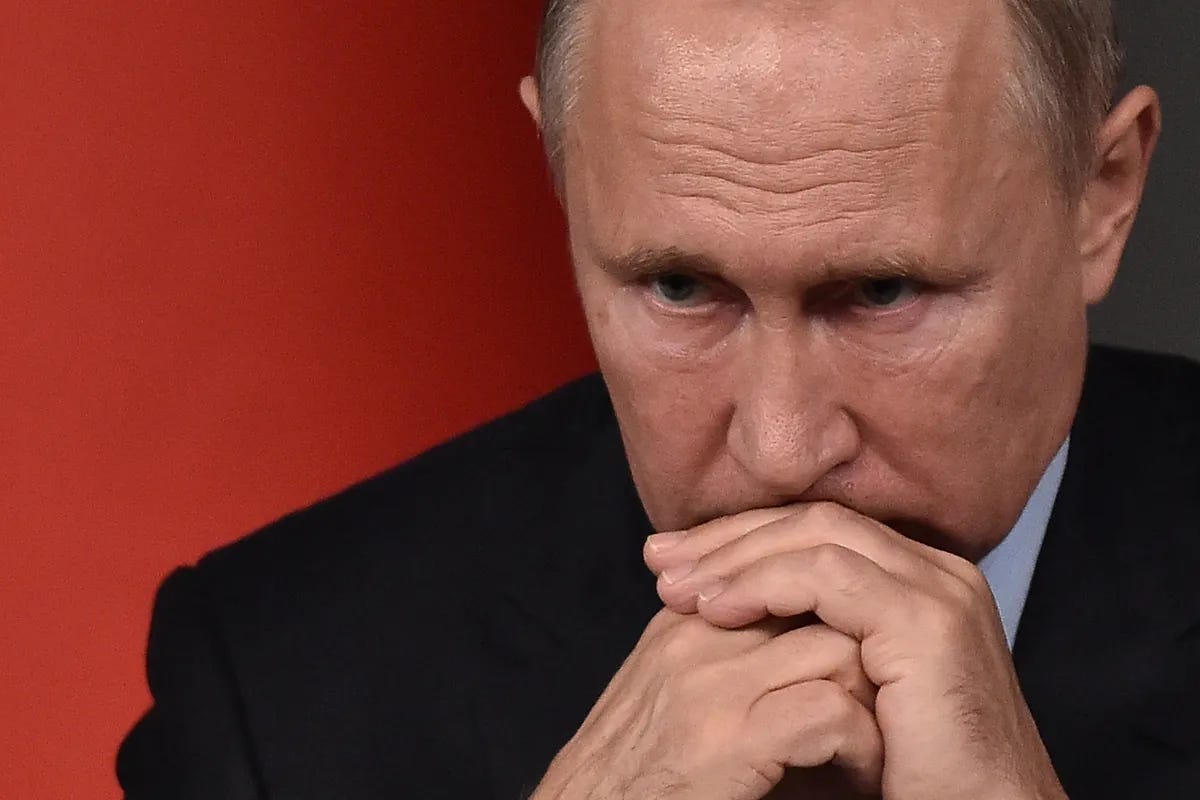
When Russian President Vladimir Putin decided to launch his all-out invasion of Ukraine in February 2022, he expected to establish control over the country within three days. He was so sure of an easy victory that he refused to call the conflict a war, dubbing it a “special military operation” instead. With that operation now in its fifth year, and as I noted recently, Ukraine gaining the upper hand, it is becoming clear just how disastrous it has turned not just for Russia but for Putin, personally.
Of course, Ukraine has suffered enormously. But if a recently leaked European intelligence report is accurate, Putin is now living in fear, spending much of his time in bunkers and worrying that he might be assassinated. The Kremlin, the report says, is now in a state of “high alert.”
Remarkably, it is not only Ukraine’s highly skilled drone operators Putin is concerned about when it comes to assassination attempts. It is the people closest to him.
According to the report:
Since the beginning of March 2026, the Kremlin and Vladimir Putin have been concerned about a leak of sensitive information and, at the same time, about the risk of a plot or coup attempt against the Russian president. In particular, he fears the use of drones for a possible assassination attempt by members of the Russian political elite.
The report was compiled by the intelligence service from a European Union country and obtained by the respected Russian investigative outlet Important Stories. Of course, it’s possible the report is part of a disinformation campaign, but as Important Stories notes, many of the details in the document have been corroborated not only by its own work but also in public settings by Kremlin officials.
According to the European intelligence, Putin worries about an assassination attempt by members of the “Russian political elite.” In other words, Putin is afraid that the very men who have under his rule accumulated immense power and wealth may be out to kill him.
That their loyalty to Putin could be fraying is perhaps understandable against the backdrop of the stalled campaign in Ukraine, a sputtering economy and a string of bomb attacks in Moscow targeting Russian military officials over the past year. Suddenly, Putin the strongman, who has staked much of his legacy on defeating Ukraine, does not look invincible.
Ordinary Russians have now started complaining on social media about the situation at levels not seen in years.
The overall picture shows that Ukraine’s astonishing success in fending off the much larger Russian military’s onslaught has created deep cracks inside the security apparatus that Putin built since he came to power more than a quarter century ago.
That, in turn, has driven three major sources of anxiety for the Kremlin and the Putin family, as described in the intelligence document: first, the possibility of a coup and/or an assassination plot against Putin; second, the emergence of heightened tensions and mistrust among the siloviki, as the men who run Russia’s powerful security services are known; and third, the rise of the Federal Protective Service, or FSO, as the domestic security agency Putin trusts above all others. In achieving that position of trust, the FSO has apparently elbowed out the Federal Security Service, or FSB, which is the main successor to the Soviet-era KGB.
Putin, according to the report, is particularly concerned about long-time former Defense Minister Sergei Shoigu, who was removed from his post in 2024 and now serves as secretary of the Security Council. Shoigu has been perched at or near the top of Russia’s military hierarchy for decades and was very close to Putin for much of that time. But something seems to have shifted in early March, when Shoigu’s first deputy was arrested. That is also when, according to the report, Putin’s fears climbed exponentially and new security measures were put in place.
Since then, Putin and his family have stopped using their homes in the Moscow area. Those around Putin are not allowed to carry cellphones, and the FSO has installed cameras and other surveillance systems in the homes of staffers, including cooks and bodyguards. In addition, large areas of Moscow are suddenly experiencing unexplained internet shutdowns.
Important Stories said it was able to independently corroborate some of the report’s claims. For example, an active-duty FSB officer told the outlet that his unit was having trouble securing equipment for nonpolitical criminal investigations, because:
“all the equipment has been redirected to monitor the government and other state bodies.”
Other aspects of the behind-the-scenes activity was openly, if inadvertently, confirmed by a former FSB officer, who told Important Stories that the FSO, not the FSB, was carrying out the internet blackouts. Important Stories said it had previously obtained information corroborating the FSO’s role in the blackouts but had withheld publishing it until the leaked intelligence report provided a second source to back it up.
If Putin is worried about untrustworthy aides, his fears would undoubtedly be compounded by the fact that details of a small but contentious meeting of top security officials ended up in the hands of a European intelligence agency.
According to the report, the meeting took place after Gen. Fanil Sarvarov was killed in Moscow in a car bomb attack last December. The assembled security chiefs reportedly started pointing fingers at each other, with tensions growing and mutual recriminations flying. The men accused each other of incompetence, of being responsible for the visible cracks in security and of failing to defeat Ukraine on the battlefield.
Security measures have now been expanded for senior figures of the military, who have also come under the protection of the FSO. But nothing comes close to the new protocols for Putin, which have had the additional effect of empowering the FSO. According to the report, Putin issued a secret presidential decree expanding the agency’s role, giving it responsibility and authority over all public information regarding Putin, including final approval over media reports about the president.
Putin has also significantly limited his public appearances, spending a great deal of time in refurbished bunkers, occasionally for weeks at a time. That practice apparently started in the early days of the war. But in contrast to his behavior in previous years, Putin has stopped visiting military installations, and he’s staying far away from his homes in Moscow.
Putin’s lower profile may not be noticeable to the Russian public, which continues to see images of him on Russian media. However, much of the footage is reportedly prerecorded.
Notably, the annual Victory Day parade on May 9, commemorating the Soviet role in defeating the Nazis in World War II was scaled back sharply this year. The parade normally features a show of military might in Red Square, and it has assumed a special role in boosting Putin’s phony claim that he’s fighting Nazis in Ukraine. This year, it was a much-reduced affair, due to fears of a potential Ukrainian drone attack.
The natural consequence of Putin’s paranoia will in all likelihood be more repression. Before long, we are likely to start seeing personnel changes at the highest levels, in addition to arrests and perhaps some more “accidental” defenestrations among key figures. All of it will be further evidence that the war in Ukraine is hitting Putin hard.
This is a version of my weekly column at World Politics Review. WPR is welcoming readers of INSIGHT by Frida Ghitis with a special rate.
That’s what happens to autocrats when the sh… hits the fan. But daring to, actually, kill him may rekindle the story of Hitler’s many assassination attempts. But, you never know
We can only hope!