
The 60 Minutes Warning
The spiked story is a red flag about US democracy

The loss of freedoms in a democracy tends to come gradually. Cassandras warn about “risks” and “dangers.” Then one day, the possibility, the fear that something can happen, materializes into reality.
That’s what happened on Sunday night, when the venerable 60 Minutes program, the preeminent provider of broadcast investigative journalism in the United States, suddenly announced it was cancelling an already-announced segment on one of the most controversial practices of the Trump administration, its deportation of migrants to a prison in El Salvador known for torture and other human rights violations, even according to the U.S.
It was not difficult to connect the dots. In fact, I pre-connected them a few weeks ago, when I warned about the dangers inherent in a Wall Street battle over the future of Warner Bros. Discovery, which owns CNN. (Disclosure: I am a paid CNN contributor.)
With the network’s future at stake, I wondered:
“Will new owners pressure CNN into promoting their views and supporting their political or financial interests? Will CNN be forced to reshape its coverage by the funders of current bids, or as payoff for government approval of a deal?”
Now we know.
At daybreak on Monday, just hours after CBS spiked the 60 Minutes segment, Paramount, the owners of CBS, which broadcasts 60 Minutes, announced a sweetened bid for WBD.
You’ll recall, two media giants, Netflix and Paramount-Skydance, want to buy WBD. WBD’s board announced it accepted the Netflix offer, hinting that the Ellis family, which controls Paramount, was not offering enough of its own money. Now Larry Ellison, whose son is Paramount’s CEO, put $40 billion on the line.
Earlier, WBD Chairman Samuel Di Piazza had mused that, “Doing a deal is great; closing a deal is better.”
To close a deal in this corrupt era, it is indispensable to gain President Donald Trump’s approval, and Trump had made it clear that he was not happy so far with 60 Minutes. He had already announced that he would be involved in the decision, even though authorities are supposed to look at potential threats to competition, which deal is better for the public, not which buyer is more personally beneficial to the president.
A few days ago, as Paramount was brainstorming how to win WBD, Trump sent a message that he was unhappy with 60 Minutes since the Ellisons bought CBS. The feds had approved the Paramount merger with the Ellisons’ Skydance after Paramount paid Trump $16 millions to settle a bogus lawsuit. It was already an affront to the First Amendment.
Now Trump sent his smoke signal, which Paramount clearly understood: 60 Minutes would have to treat him better.
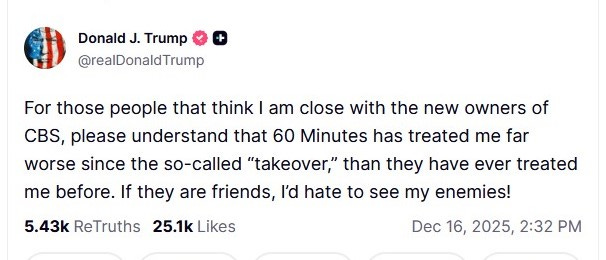
It’s reasonable to conclude that this is the reason CBS did not broadcast the story.
The segment that was supposed to air Sunday night would have revealed just how shocking the deportations to El Salvador’s CECOT prison are.
Here’s the promo that had already aired
CBS said the segment “needed additional reporting” and would air at a later date. But the reporter, Sharyn Alfonsi, told her colleagues in a private note that pulling the story is “not an editorial decision, it is a political one.”
At the heart of controversy stands Bari Weiss, the journalist hand-picked by David Ellison to run CBS News. She defended the decisions, saying, “My job is to make sure all stories we publish are the best they can be.” She claimed that “Holding stories that aren’t ready for whatever reason,” is something that “happened every day in every newsroom.”
But shelving a 60 Minutes story critical of the administration only moments before it’s about to air, in the middle of a battle for the president’s approval of a merger, is not routine. And the timeline here is beyond suspicious. It is damning.
Given the strong editorial track record of 60 Minutes, Alfonsi’s explanation in a note to CBS colleagues obtained by the New York Times is very credible:
“Our story was screened five times and cleared by both CBS attorneys and Standards and Practices” She added. “It is factually correct. In my view, pulling it now, after every rigorous internal check has been met, is not an editorial decision, it is a political one.”
Weiss had reportedly demanded multiple changes. Among other things, she said, the story should include an interview with Deputy Chief of Staff Stephen Miller, who has crafted the unprecedentedly brutal crackdown on migrants. But Alfonsi said she and her team had tried to get the administration’s side, unsuccessfully requesting comments from the White House, the State Department and the Department of Homeland Security.
Then she made a very good point: “If the administration’s refusal to participate becomes a valid reason to spike a story, we have effectively handed them a ‘kill switch’ for any reporting they find inconvenient.”
Whether or not the segment ever airs, this incident is cause for alarm. Every democracy that has gone down the road of authoritarianism has made control of the media a centerpiece of their strategy. From Vladimir Putin to Viktor Orban, they have punished outlets that disparaged them and used their power to make their friends and allies end up owning the most influential private news organizations.
What we saw Sunday night – what we did not see – is a sign of what’s at stake. If respected news programs cannot air well-researched pieces that are critical of government policy, the people of the United States risk losing one of their most important freedoms, the freedom to know what the government is doing in their name. That risk is already becoming reality.
I’ve been horrified by this subtle takeover of the media as well. My dream would be for this story to be shared on some other platform. I keep praying Ellison will not be able to take over WBD.
Then the reporter, [Sharyn Alfonsi] made a very good point: “If the administration’s refusal to participate becomes a valid reason to spike a story, we have effectively handed them a ‘kill switch’ for any reporting they find inconvenient.”
Brava!