
Iran is Overplaying its Hand
An overconfident Tehran risks pulling failure from the jaws of success
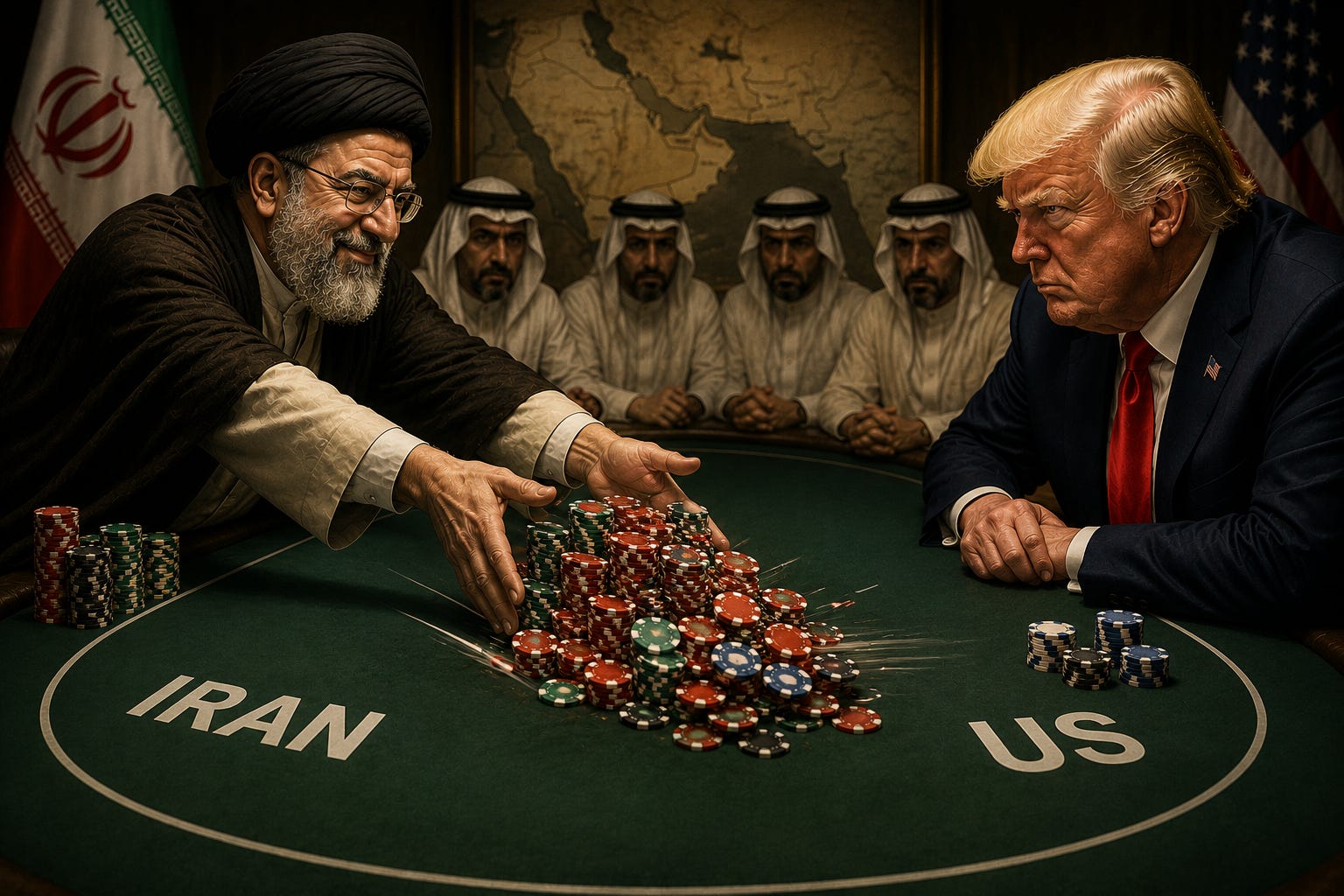
There’s no question that the war Israel and the United States launched against Iran five months ago did not go as planned, and that the planning itself left much to be desired. The Iranian regime survived and left President Trump with few good options. But the war is not over and Iran is overplaying its hand.
Instead of consolidating what it sees as a victory, Tehran continues to test Washington, seemingly inviting another round of war. It’s unclear what’s motivating Iran’s provocative actions after the U.S. had agreed to pause strikes against Iran. It may reflect overconfidence, ideological zeal, or even the belief among some regime hardliners that an apocalyptic confrontation will hasten the return of the Mahdi and usher in a global Islamic order.
I’m inclined to believe the moves are not about the world to come but about the immediate future. Islamic Revolutionary Guards Corps (IRGC) leaders not only see that they have won the first round, but they believe time is on their side because they pay close attention to Western politics and media. Another round, they may conclude, will solidify their gains.
They know Trump has no easy options. They know his approval ratings are weighed down by high oil prices. They want to keep complete control of the Strait of Hormuz and they know Trump is profoundly reluctant to deploy U.S. troops to reverse that. They know he wants this war to end.
It’s possible their bet will pay off. That they will essentially outlast Trump. But they are pushing too far and they may just grab defeat from the jaws of victory.
Already their tactics have set the stage for long term losses for Iran. By closing the Strait of Hormuz and attacking neighboring states, Iran sparked a rush to develop alternative export routes. Over time, that will sharply erode one of Tehran’s most powerful strategic tools. Those attacks have created a level of mistrust that will not soon fade away.
But those are long-term implications. The more urgent matter is what happens now, and there too, Iran’s tactics could become counterproductive.
Iran is launching attacks throughout the region that are sparking fury from Washington to Riyadh. In the midst of a tacit ceasefire, Iran fired at U.S. targets in the region, prompting an angry Trump to declare crassly on Fox News, “We’re going to beat the fucking shit out of them.”
By now, Trump’s over-the-top threats sound a bit like the Boy who Cried Wolf, usually backing down, Hence the TACO moniker. But can Iran be sure that Trump won’t reach his limit? Trump is acutely sensitive to appearing weak and, while all his options are potentially risky, he does command the world’s most powerful military.
Iran may also discover that its neighbors are running out of patience. After enduring missile and drone attacks and engaging mostly in defensive maneuvers, Saudi launched fighter jets to join U.S. forces in strikes against Iran-backed militias in Iraq.
In recent days, Iran has attacked Saudi Arabia, the United Arab Emirates, Jordan, Kuwait, Oman, Qatar, Bahrain and even Egypt. And the activation of the Iran-backed Houthis in Yemen, striking tankers in the Red Sea, threatens the vital output of the Saudi East-West oil pipeline. Tehran risks turning nearly every Arab government in the region into an active opponent.
On Tuesday, Israeli Prime Minister Benjamin Netanyahu met with Trump in the Oval Office. The White House had little to say about the talks, but Netanyahu claimed their talks were, “one of the best conversations I’ve ever had with a president of the United States.” We don’t know what exactly he heard. Netanyahu faces elections in October, so his words have to be seen in that context, but his upbeat characterization suggests he may believe that Washington has not ruled out military action against a regime that spent decades vowing to destroy Israel.
The regime in Tehran has survived until now. That’s an impressive accomplishment. But Iran is in deep trouble for many reasons. The vast majority of Iranians despise it. After security forces massacred tens of thousands of protesters in just two days last January and then stepped-up executions of young people, it’s unlikely a major uprising will erupt now. But internal cracks have emerged, as I noted in April. That is a genuine threat. Whoever is effectively running the regime – supreme leader Mojtaba Khamenei has not been seen for months – doesn’t have the legitimacy of the late Ali Khamenei.
With the economy in shambles, inflation spiraling out of control, and the war not over, the possibility that a segment of the ruling class will decide to challenge the unstable status quo cannot be discounted.
Those currently driving Tehran’s strategy are perpetuating war, risking continuing destruction of Iran’s infrastructure, creating enmity with neighbors and destroying the economy. Inflation has become so severe that even members of Iran’s security services—the military, the Revolutionary Guards and the Basij—are struggling with the rising cost of living. A regime whose armed defenders grow restless faces a dangerous vulnerability.
Several paths remain possible from here. Trump could ultimately accept another flawed agreement that leaves Iran stronger over the long term. An uneasy stalemate could emerge, punctuated by periodic strikes, sanctions, and continued disruptions to shipping through Hormuz. That remains the most likely outcome. But there is another possibility that Tehran appears to underestimate: by overplaying its hand, the Islamic Republic could trigger the very chain of events that ultimately brings about its own unraveling.
Iran wins by not losing. Agree that they may lose strategic asset in Strait of Hormuz but as long as someone buys their oil (hello China), they will have the money to continue to fund proxies and build an arsenal.
"Those currently driving Tehran’s strategy are perpetuating war, risking continuing destruction of Iran’s infrastructure, creating enmity with neighbors and destroying the economy."
Those currently driving Trump's strategy are facing similar difficulties, as well as falling polls.